
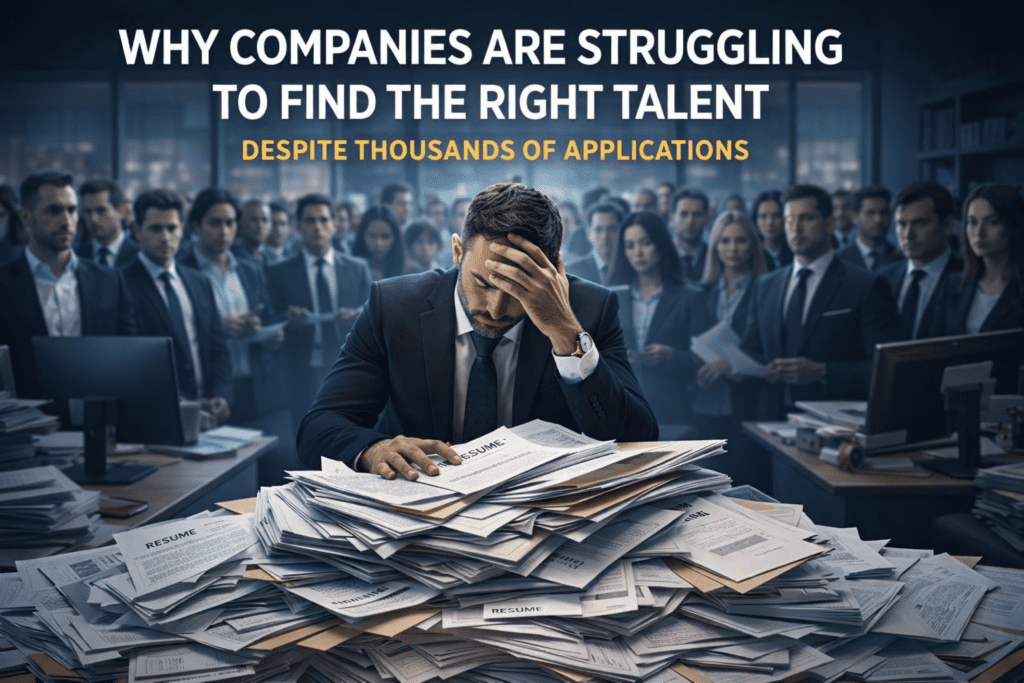
Finding talent should be easier in 2026 than it has ever been before. Millions of people are actively looking for work, layoffs have pushed experienced professionals back into the market, and job platforms make it possible for candidates to apply within seconds. Yet companies across industries continue to say the same thing, “finding the right person has become harder, not easier.”
This is what makes today’s hiring market so unusual. Businesses are surrounded by applications, but still struggling to build strong teams. Roles remain open for months, projects slow down, managers become overloaded, and existing employees face more pressure because companies cannot find people who are truly ready for the work.
The problem is no longer about how many people are applying. It is about whether companies are looking for the right things and whether hiring systems are still designed for the world businesses operate in today.
The Hiring Crisis Nobody Expected
Applications per role have doubled since 2022, but 66% of recruiters say finding the right people is harder than ever. In India, talent shortage has reached 82%, while 53% of recruiters say AI-generated resumes are making it difficult to identify real skills. Companies are not struggling to attract applicants anymore. They are struggling to find people who can actually adapt, solve problems, and deliver results.
A large number of applications can create the impression that companies have more options than ever before. In reality, too much volume is often making it harder to identify strong candidates. LinkedIn research shows that applications per role have doubled since 2022, yet 66% of recruiters say finding qualified talent is now more difficult.
Recruiters are no longer just reviewing resumes. They are sorting through hundreds of similar profiles that use the same keywords, the same polished language, and the same carefully structured achievements. Many candidates now use AI tools to write resumes, create cover letters, and apply for multiple roles at once.
That has created a hiring environment where many people look impressive on paper, but far fewer can prove they are the right fit when interviews begin. In India, 53% of recruiters say AI-generated applications are making it harder to identify genuine talent because too many candidates appear stronger in documents than they do in real conversations.
A few years ago, a strong resume was often enough to stand out. Today, it is becoming harder to know whether a polished application reflects real capability or simply a good understanding of how hiring systems work. When every profile sounds equally impressive, companies stop trusting what they see.
Outdated Hiring Models in a Changing Workforce
Many companies are still hiring based on older ideas of what makes someone qualified. Degrees, years of experience, and previous job titles still carry a lot of weight in recruitment, even though the skills businesses need today are very different from what they needed a few years ago.
Companies now want employees who can adapt quickly, learn new tools, handle uncertainty, and work across different functions. Skills like AI literacy, communication, data analysis, cybersecurity awareness, and problem-solving are becoming important across almost every industry.
India’s talent shortage has now reached 82%, despite having one of the largest workforces in the world. That is because businesses are often looking for modern skills through outdated hiring filters. They say they want future-ready employees, but many still hire based on past experience instead of future potential.
Many businesses say they want innovation, but still recruit people who look exactly like the last person who left. That may feel safer, but it often prevents companies from building teams that can adapt when the market changes.
The Decline of Resume Credibility
One of the biggest mistakes companies make is assuming that the strongest candidate will also have the strongest resume. Some of the most capable employees may not have degrees from top universities or experience at famous companies. They may have changed industries, taken career breaks, or built skills in less traditional ways.
Those candidates are often overlooked because hiring systems are still designed to reward perfect career paths. But modern business rarely rewards perfection. It rewards people who can keep learning, solve problems quickly, and stay useful when conditions change.
As more technical work becomes automated, human qualities are becoming more valuable. Communication, emotional intelligence, leadership, resilience, and decision-making are now some of the most important skills companies can hire for. These are the qualities that help teams perform under pressure, yet they are also the hardest to measure through a resume.
A resume can show where someone has worked. It cannot always show how they think, how quickly they learn, or how they react when things go wrong. Those qualities often matter far more once someone is inside the business.
The Value of Internal Mobility
Many organizations spend too much time searching for talent outside the business while ignoring the people already inside it. Employees who understand the company, know the customers, and have experience with the culture are often overlooked simply because they do not have the exact title or experience listed in the job description.
That is becoming a costly mistake. Companies that invest in internal mobility, upskilling, mentorship, and leadership development are often solving talent shortages faster than companies that rely only on external hiring. Internal employees usually need less time to become productive because they already understand how the business works.
Sometimes the right person is not missing at all. They are already inside the company, waiting for an opportunity to grow. The companies that recognize this early are often the ones that build stronger teams over time instead of constantly restarting the hiring process.
Conclusion
The hiring crisis in 2026 is not really about a lack of talent. It is about a growing gap between what companies need and how they continue to search for it.
Businesses are receiving more applications than ever before, but many are still relying on old hiring systems, outdated filters, and unrealistic expectations. They want adaptable, future-ready employees, but they still recruit based on degrees, job titles, and perfect resumes.
The companies that will build the strongest teams in the years ahead will not necessarily be the ones with the biggest hiring budgets. They will be the ones that know how to spot potential, invest in people, and recognize that talent is no longer defined by what someone did in the past. It is defined by how quickly they can grow, learn, and create value in the future.
Frequently Asked Questions
1. Why are companies struggling to find the right talent in 2026?
Companies are receiving more applications than ever, but many candidates do not have the exact skills, adaptability, or practical experience businesses now need.
2. How is AI making hiring more difficult?
AI is helping candidates create resumes and apply for jobs faster, which is increasing application volume. This makes it harder for recruiters to identify who is genuinely qualified.
4. What skills are companies looking for most today?
Businesses want employees who can adapt quickly, communicate well, solve problems, work with AI tools, and handle change.
5. Why are companies focusing more on internal talent?
Employees already inside the business often understand the culture, systems, and customers better, which helps them become productive faster than external hires.