
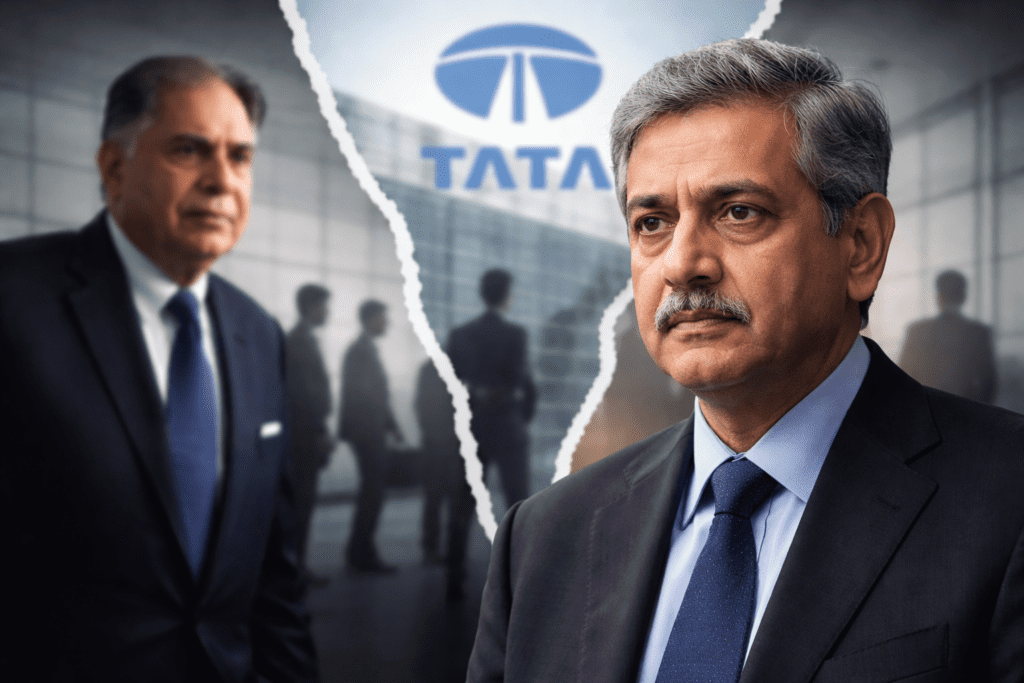
Barely 18 months after the death of Ratan Tata, the internal conflict inside Tata Trusts is turning into the biggest leadership challenge yet for Noel Tata.
What began as a legal dispute over trustee eligibility has now grown into a much larger fight involving governance, forced resignation allegations, boardroom divisions, and increasing pressure to publicly list Tata Sons. The bigger question is whether Noel Tata can keep one of India’s most influential business groups united during a period of rising internal conflict and financial pressure.
Non-Parsi Row Triggers Conflict
The immediate trigger came after former trustee Mehli Mistry challenged the appointments of Venu Srinivasan and Vijay Singh to the Bai Hirabai Jamsetji Tata Navsari Charitable Institution.
Mistry argued that the trust’s original 1923 deed allowed only Zoroastrian trustees who lived in the old Bombay Presidency. That complaint led Srinivasan to resign from the Bai Hirabai Trust on April 4, while Singh chose not to step down immediately. The controversy became even more serious after both men reportedly claimed they were not informed about a 2000 legal opinion by former Chief Justice MH Kania, which had earlier ruled that such restrictive clauses were invalid and that non-Parsi trustees were legally allowed.
The dispute has now exposed a deeper governance problem inside Tata Trusts. Trustees have accused the organization’s CEO of urging them to resign without sharing all the relevant legal information. That has raised fresh concerns about transparency and decision-making inside the trust structure.
IPO Fight Intensifies
At the center of the larger conflict is the future of Tata Sons.
For years, Tata leadership has preferred to keep Tata Sons private. But that position is now being challenged more openly than ever before. Srinivasan has publicly supported a Tata Sons listing, saying it may become inevitable if the Reserve Bank of India continues to classify the company as an upper-layer non-banking finance company. Singh has also backed a listing, saying the group’s expansion into sectors such as semiconductors, defence, batteries, aviation, and electronics will require more capital than Tata can generate internally.
The pressure increased further this week after Shapoorji Pallonji Mistry renewed his demand for a Tata Sons IPO, calling it a “necessary evolution” that would improve governance, accountability, and transparency. The Shapoorji Pallonji Group owns about 18.37% of Tata Sons and has been pushing for a public listing for several years.
Air India Losses Worsen Crisis
The listing debate is becoming more urgent because Tata Group is facing growing losses across several businesses.
According to internal estimates reviewed this week, Tata Sons’ newer ventures may report combined losses of nearly ₹29,000 crore in FY26, far above the earlier estimate of ₹5,700 crore. Much of that pressure is coming from businesses such as Air India, Tata Digital, semiconductors, batteries, and other newer investments.
Noel Tata has reportedly raised concerns about the scale of these losses and has asked leadership to explore ways to reduce debt and keep Tata Sons private. But the worsening financial picture is making that position harder to defend. Supporters of a listing believe public markets would provide easier access to capital while also increasing accountability.
Noel Tata Faces Tough Leadership Challenge
The biggest risk for Noel Tata is that more senior voices inside the Tata ecosystem are now publicly backing a listing.
Srinivasan and Singh, the two trustees at the center of the non-Parsi row, have both openly supported an IPO. The Shapoorji Pallonji Group is also increasing pressure. Even regulators could eventually force Tata Sons to list if the RBI maintains its current NBFC classification.
That means Noel Tata is no longer just dealing with an internal trustee dispute. He is facing a larger battle over the future direction of Tata Group itself.
For decades, Tata’s reputation was built on stability, long-term thinking, and avoiding public conflict. But the current fight has become Noel Tata’s first real leadership test since taking over after Ratan Tata. Whether he can restore unity and control inside Tata Trusts may now shape the future of one of the world’s most respected business groups.