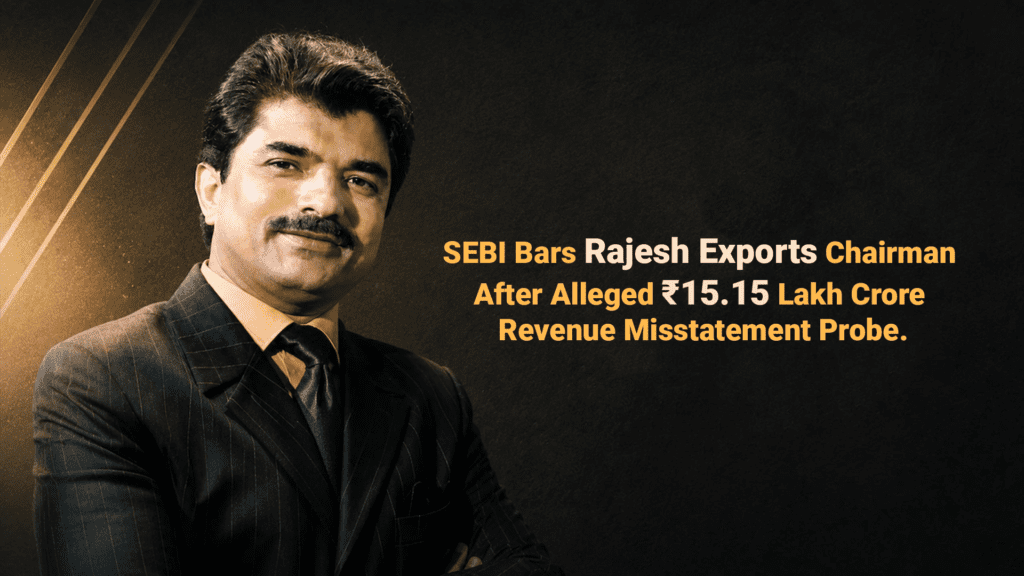
Rajesh Exports Ltd spent years reporting revenues that placed it among India’s largest listed companies by turnover. Those numbers are now at the center of a major regulatory investigation after the Securities and Exchange Board of India (SEBI) alleged that the company overstated its consolidated revenue by approximately ₹15.15 lakh crore between FY2021 and FY2025.
In an interim order issued on June 3, 2026, SEBI barred Chairman and Managing Director Rajesh Mehta from accessing the securities market and directed a fresh forensic audit of the company’s financial records. The action followed an investigation that began after a shareholder complaint raised concerns regarding outstanding receivables and financial disclosures.
The size of the alleged discrepancy has made the case one of the most closely watched corporate investigations in India. The amount questioned by the regulator is larger than the annual revenue of many major listed companies and has triggered fresh discussions around corporate disclosures, overseas subsidiary reporting, and financial transparency.
The Investigation Begins
The matter first came under scrutiny after a shareholder complaint submitted in March 2024 raised questions about delayed receivables and the company’s financial reporting. The complaint eventually led to a wider examination of Rajesh Exports’ books, overseas operations, and consolidated financial statements.
SEBI’s review focused heavily on the company’s international business structure, particularly Valcambi SA, the Switzerland-based precious metals refiner acquired by Rajesh Exports in 2015. According to the regulator’s interim findings, between 97% and 99% of the company’s reported consolidated revenue during FY2021-FY2025 originated from overseas subsidiaries.
During the examination, SEBI alleged that approximately ₹15.15 lakh crore of reported consolidated revenue could not be adequately supported through the records reviewed during the investigation. The regulator also questioned whether certain gold-related transactions were recorded in a manner that accurately reflected the underlying economic activity.
Because such a large share of the company’s reported turnover originated from overseas operations, the regulator concluded that a deeper forensic examination was necessary before the matter could move forward.
Financial Reporting Concerns
One reason the case has attracted so much attention is the gap between Rajesh Exports’ reported scale and the questions raised during the investigation. For several years, the company reported annual revenues running into lakhs of crores, placing it among the country’s largest listed businesses by turnover.
SEBI’s order points to concerns regarding how revenue generated through overseas entities was recorded and consolidated into the group’s financial statements. Valcambi SA became a central focus because of its importance within the company’s global operations.
The regulator has not issued a final conclusion on the matter. However, the interim findings indicate that investigators were unable to satisfactorily verify substantial portions of the reported revenue through the records examined during the review process. These concerns ultimately formed the basis for the fresh forensic audit ordered by SEBI.
The forensic audit will play a central role in examining the records linked to the transactions identified during SEBI’s review.
Fund Flow Allegations
The investigation extends beyond revenue reporting. According to SEBI’s interim order, approximately ₹339 crore of company funds were allegedly routed through accounts linked to Rajesh Mehta and related entities without approvals generally expected for such transactions.
The regulator also highlighted transactions involving Affluence Shares and Stocks Pvt. Ltd. SEBI stated that Rajesh Exports reported sales worth ₹11,487 crore and purchases worth ₹11,488 crore involving the entity. During the investigation, questions emerged regarding the commercial substance and supporting documentation associated with these transactions.
These findings widened the scope of the review and brought additional attention to the company’s governance practices and financial controls. Consequently, the forensic audit will examine not only revenue reporting but also the movement of funds and the documentation supporting key transactions.
At this stage, these remain allegations contained in an interim regulatory order and have not been established as final findings.
Rajesh Exports Responds
Rajesh Exports has rejected the allegations and maintained that its financial disclosures are accurate. The company has argued that the regulator’s conclusions stem from differences in interpreting revenue generated through overseas operations rather than from any deliberate misstatement.
Management has stated that the order is interim in nature and does not represent a final determination. The company has also indicated that it is cooperating with the regulatory process and preparing additional documentation to support its position.
The market reaction was immediate. Rajesh Exports shares came under significant pressure after the order became public, reflecting concerns about the allegations and the uncertainty surrounding the investigation. The case also attracted attention because of the company’s shareholder base. According to recent disclosures, Life Insurance Corporation of India (LIC) held approximately 10.8% of the company, while publicly reported lender exposure linked to Canara Bank exceeded ₹500 crore.
The combination of regulatory action, investor concerns, lender exposure, and questions surrounding reported revenue has turned the matter into one of the biggest corporate governance stories currently unfolding in India’s capital markets.
The Forensic Audit
The next stage of the case will largely depend on the findings of the forensic audit ordered by SEBI. The review is expected to examine accounting records, overseas transactions, fund flows, and supporting documentation linked to the revenue figures highlighted in the regulator’s order.
The investigation remains ongoing, and SEBI’s observations currently form part of an interim order. Rajesh Exports continues to deny the allegations and has stated that it will provide additional records during the proceedings. The forensic audit will now become the next major step in the proceedings as regulators continue examining the company’s reported revenue, overseas operations, and financial disclosures.
Frequently Asked Questions
1. Why did SEBI take action against Rajesh Exports?
SEBI alleged that Rajesh Exports overstated its consolidated revenue by approximately ₹15.15 lakh crore between FY2021 and FY2025 and raised concerns regarding certain transactions and fund flows.
2. What is the significance of the ₹15.15 lakh crore figure?
The amount represents a substantial portion of the company’s reported consolidated revenue during the review period, making it one of the largest alleged revenue misstatement cases currently under regulatory examination.
3. What role does Valcambi SA play in the investigation?
Valcambi SA, the Switzerland-based precious metals refiner owned by Rajesh Exports, was a key focus because a large share of the company’s reported revenue originated from overseas subsidiaries.
4. How has Rajesh Exports responded to SEBI’s allegations?
The company has denied wrongdoing, stated that its financial disclosures are accurate, and said it will provide additional documentation to support its position during the proceedings.
5. What happens next in the Rajesh Exports case?
SEBI has ordered a fresh forensic audit to examine financial records, transactions, and supporting documents. The findings of that audit will play an important role in the ongoing regulatory review.