
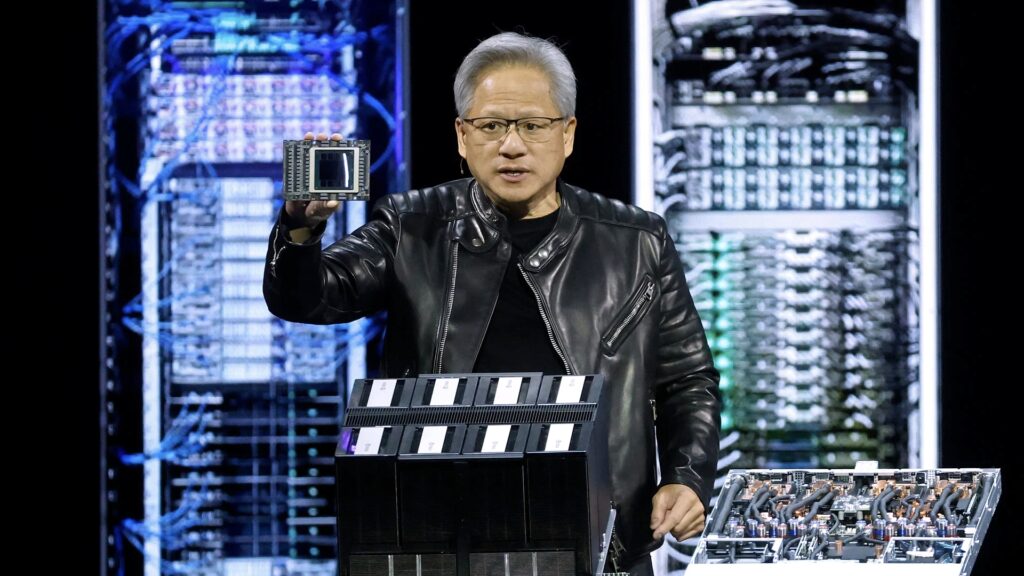
Nvidia CEO Jensen Huang has sharply criticized corporate leaders who are blaming artificial intelligence for layoffs, calling the narrative “lazy” and “irresponsible” during a recent interview with Singapore broadcaster Channel NewsAsia (CNA). His comments come at a time when companies across the global technology sector are increasingly linking workforce reductions, restructuring plans, and hiring slowdowns to AI transformation strategies.
Huang questioned how companies could claim AI is already responsible for major job losses when generative AI has only recently become commercially productive at enterprise scale. “How is it possible that AI became productive and useful only six months ago, and they were somehow laying people off two years ago because of AI?” Huang said during the interview. He also accused some executives of using AI explanations simply to “sound smart,” warning that such messaging is unnecessarily scaring workers and creating confusion around how AI is actually being used inside companies.
AI Layoff Panic Grows
Huang’s remarks arrive during one of the biggest workplace transitions the technology industry has seen in years. According to Layoffs.fyi, more than 260,000 tech workers lost their jobs globally during 2025 as companies continued post pandemic restructuring and cost reduction efforts. Several firms simultaneously accelerated investments into AI infrastructure, automation tools, and generative AI systems while reducing operational spending elsewhere.
In recent months, executives across banking, consulting, software, and media sectors have increasingly referenced AI efficiency gains while discussing workforce restructuring. That trend has intensified concerns among employees who fear AI could permanently replace portions of white collar work, especially in operations, customer support, software development, and administrative roles.
However, Huang believes many of these workforce cuts are being incorrectly framed as AI driven transformation when the deeper causes are often slowing growth, investor pressure, overhiring during the pandemic era, and broader economic restructuring.
Nvidia’s Growth Vision
Unlike some corporate leaders focusing heavily on automation and labor reduction, Huang continues pushing a much more expansion focused AI vision.
Nvidia itself remains one of the largest beneficiaries of the global AI boom. The company reported record revenue growth driven by soaring demand for AI chips powering systems developed by OpenAI, Microsoft, Meta, Amazon, and Google. Nvidia’s market value recently crossed several trillion dollars as companies worldwide continued increasing AI infrastructure spending.
Huang argues that businesses with strong leadership should use AI to create new products, improve productivity, accelerate innovation, and enter new markets instead of primarily treating the technology as a cost cutting tool. He pointed to Nvidia’s own growth as an example, saying the company is hiring aggressively and expanding operations because of AI demand rather than reducing its workforce.
His criticism is especially important because Nvidia currently sits at the center of the AI economy. The company’s chips and infrastructure now power many of the world’s most advanced generative AI systems, giving Huang unusual influence in the global conversation around AI and jobs.
Learn AI or Get Left Behind
While Huang rejected the idea that AI alone is destroying jobs, he also delivered a direct warning to workers who ignore the technology.
“You’re not going to lose your job to AI. You’re going to lose your job to somebody who learned AI better than you,” Huang said. He compared the current AI shift to the rise of personal computers decades ago, arguing that computers did not eliminate work entirely but rewarded people who adapted faster to new tools and workflows.
That message is already shaping hiring expectations across industries. LinkedIn’s 2026 Workplace Learning Report found that AI literacy and generative AI related skills are among the fastest growing requirements in professional hiring globally. Many companies are now encouraging employees to integrate AI tools into daily work across engineering, marketing, operations, analytics, and communication functions.
Huang’s comments have now shifted the AI layoffs debate beyond technology itself and toward leadership accountability. As companies continue restructuring around artificial intelligence, the larger question emerging across the corporate world is whether AI is genuinely replacing jobs at scale or whether some executives are using AI as a modern explanation for traditional cost cutting decisions.