
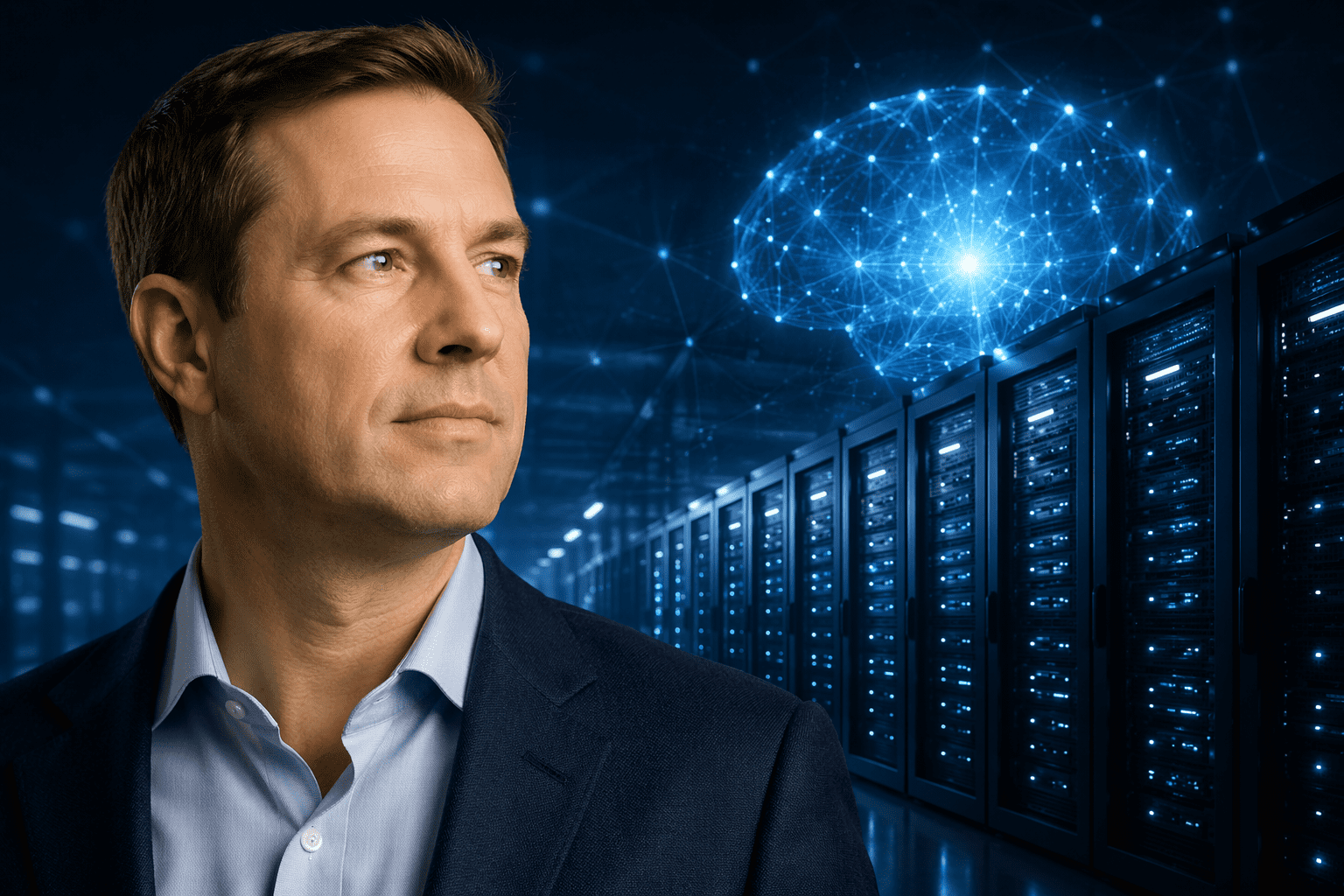
While most of the world was still talking about chatbots and Nvidia chips, Wes Cummins was thinking about transformers, cooling systems, fiber networks, and empty land in North Dakota.
Applied Digital’s CEO did not build another AI app or software platform. He focused on the physical systems behind artificial intelligence long before the market realized how important they would become.
While many executives were still talking about software, he was thinking about energy access, construction timelines, utility approvals, and the growing shortage of data center capacity. In a market crowded with bold claims and billion-dollar announcements, that practical approach has given Applied Digital an early advantage.
The Hidden AI Bottleneck
Many business leaders believed the biggest challenge in AI would be getting access to GPUs. Cummins believed the real challenge would be everything around the GPUs. He understood that even the most advanced chips would become useless if companies could not find enough electricity, cooling, land, or construction capacity to support them.
Applied Digital moved into AI infrastructure much earlier than most competitors. Before ChatGPT became a global story, the company had already started building GPU cloud services and experimenting with high-performance computing environments. Cummins saw that AI demand was rising faster than the market understood, and he realized that companies would soon need hundreds of megawatts of computing power instead of small pilot projects.
Applied Digital reported $126.6 million in revenue in its latest quarter, up 139 percent year over year, driven largely by its AI and high-performance computing business. The company also says it now has around $16 billion in contracted lease revenue tied to long-term infrastructure deals.
Applied Digital’s Big Pivot
Applied Digital did not begin as an AI company. It originally focused on cryptocurrency infrastructure and large-scale mining facilities. Many businesses would have stayed in that market, especially after investing heavily in buildings, energy contracts, and equipment.
Cummins recognized that crypto mining and AI data centers shared many of the same requirements. Both needed large amounts of electricity, advanced cooling systems, dense computing environments, and access to reliable infrastructure. Instead of treating crypto as the company’s future, he treated it as a training ground for something much bigger.
One of the smartest moves in the company’s history was preparing for AI infrastructure before the rest of the market fully understood where demand was heading. While many companies only started chasing AI infrastructure after demand exploded, Applied Digital was already building for that future.
The company now operates a fully active 100-megawatt AI campus at Polaris Forge 1 in North Dakota, while additional 150-megawatt buildings are under construction. It has also broken ground on Delta Forge 1, a new campus with a project footprint of 430 megawatts and a target of 300 megawatts of critical IT load.
Microsoft, Meta, Amazon, Google, and OpenAI are all increasing spending on AI infrastructure because the next stage of artificial intelligence is no longer limited by software alone. It is increasingly limited by electricity, cooling, utility access, and how quickly companies can build. Infrastructure companies are becoming some of the most important businesses in the market.
AI Beyond Silicon Valley
Most people imagine the future of AI being built in Silicon Valley, Seattle, or New York. Cummins looked somewhere else.
Applied Digital made North Dakota one of the centerpieces of its growth strategy because it offered something more valuable than status: energy availability. The region provides cheaper land, easier permitting, lower congestion, and colder weather that helps reduce cooling costs.
The AI industry is beginning to face a serious energy problem. Data centers are consuming enormous amounts of electricity, and many of the largest markets are already struggling with power shortages and long utility wait times.
North Dakota gave Applied Digital the room to build faster than many of its competitors. Instead of waiting years for new power connections in crowded markets, Cummins focused on areas where the company could scale more quickly. Access to energy and faster construction timelines are becoming major advantages in the AI economy.
One of the biggest surprises of the AI economy is that some of its most important infrastructure may be built far away from Silicon Valley. The next generation of AI growth may happen in places with stronger utility access, lower costs, and fewer delays rather than in the traditional technology hubs people usually talk about.
The Race to Build AI Infrastructure
One of the biggest reasons Cummins stands out is because he spends less time talking about the future and more time building for it.
The AI market is full of announcements. Every month, companies promise billion-dollar campuses, giant data center expansions, and huge compute plans. Many of those projects will face delays because of shortages in transformers, switchgear, cooling equipment, skilled labor, and utility approvals.
Cummins has repeatedly argued that 2026 and 2027 will become years of execution, not only years of hype. Applied Digital locked in many of its supply chain requirements much earlier than competitors, which helped the company avoid some of the delays now affecting the broader industry.
Applied Digital’s adjusted EBITDA reached $44.1 million in the latest quarter, compared with $6.3 million a year earlier. Investors also responded positively after the earnings release, with the stock moving sharply higher following the results.
Many companies can announce billion-dollar AI projects. Much fewer companies can actually build them. Applied Digital has created its advantage by focusing on execution instead of only ambition.
Conclusion
Most leaders noticed AI when it became impossible to ignore. Wes Cummins noticed it when it was still hidden inside power grids, empty land, and rising data center demand.
He understood that the future of artificial intelligence would not only depend on software, algorithms, or chips. It would also depend on electricity, utility access, cooling, speed, and the ability to build faster than everyone else.
Applied Digital is not trying to become the next OpenAI or Nvidia. It is trying to become one of the businesses that makes those companies possible. In the next stage of the AI economy, the biggest winners may not only be the companies creating the technology. They may also be the companies building the systems that allow that technology to grow.
Frequently Asked Questions
1. Who is Wes Cummins?
Wes Cummins is the CEO of Applied Digital, a company focused on AI infrastructure, data centers, and high-performance computing. He became well known for moving early into AI infrastructure before most of the market understood how big the opportunity would become.
2. What does Applied Digital do?
Applied Digital builds and operates large-scale data centers designed for artificial intelligence and high-performance computing. The company focuses on energy access, cooling systems, and data center capacity for AI workloads.
3. Why is North Dakota important for Applied Digital?
North Dakota offers cheaper land, easier access to power, colder weather, and fewer delays around permits and construction. These advantages make it easier to build large AI campuses faster than in crowded technology markets.
4. Why are AI data centers becoming so important?
AI models need huge amounts of computing power, electricity, and cooling to run. As AI adoption grows, companies need more data centers to support that demand.
5. Why is Applied Digital becoming more valuable?
Applied Digital moved into AI infrastructure before many competitors and secured major long-term deals. Its early focus on power, land, and execution has helped it become one of the fastest-growing companies in the AI data center market.