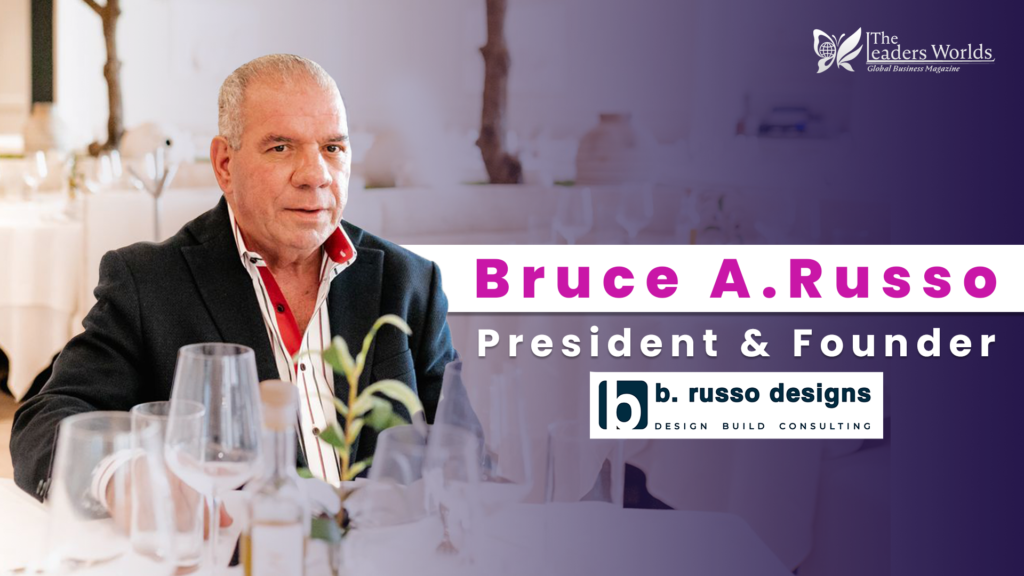
In an industry obsessed with aesthetic flourishes, one designer dares to think differently—transforming restaurants from mere dining spaces into finely-tuned operational masterpieces
When Bruce Russo walks into a restaurant, he doesn’t see what most of us see. While diners admire the ambiance and critics evaluate the menu, Russo’s trained eye dissects the space with surgical precision—tracking the flow from back-of-house to front-of-house, analyzing the three-second window that determines where customers choose to sit, and mentally reconstructing the entire operation as what he calls “a manufacturing facility.”
This unique perspective has made B. Russo Designs one of America’s most sought-after hospitality design firms, but more importantly, it has redefined how the industry thinks about restaurant spaces entirely.
THE AWAKENING: WHEN FUNCTION MEETS FORM
Russo’s journey began with a startling realization that would shape his entire career philosophy. “Studying the products that were being built in the hospitality market, it was obvious that the function of the restaurants that were being designed and built was being totally ignored,” he recalls. This observation wasn’t just casual criticism—it was the genesis of a revolutionary approach that would challenge decades of conventional design wisdom.
In an era where restaurant design was dominated by aesthetic considerations and Instagram-worthy moments, Russo saw an industry fundamentally missing the point. Beautiful spaces were failing operationally. Stunning dining rooms were supported by kitchens that created bottlenecks, inefficiencies, and ultimately, frustrated staff and disappointed customers. This revelation inspired him to establish a design firm with a radically different mission: focus strictly on the marriage of function and design. “Staying true to our original goal, we have become one of the top award-winning design firms in the United States,” Russo says—a testament to the power of getting the fundamentals right before worrying about the flourishes
THE MANUFACTURING MINDSET: RESTAURANTS AS PRECISION MACHINES
Perhaps no aspect of Russo’s philosophy is more transformative than his manufacturing metaphor. “The key to successful restaurant design is to stay focused on the fact that what is being designed is a manufacturing facility,” he explains. “Raw goods are delivered at the back service door, the products delivered are then processed by the chef and the staff and then delivered to the client in the front of house.”
This industrial perspective might seem cold for an industry built on hospitality and human connection, but it’s precisely this analytical approach that creates the foundation for genuine hospitality to flourish. When operations flow seamlessly, staff can focus on service rather than navigating poorly designed spaces. When kitchen workflows are optimized, food quality and consistency improve. When the entire operation functions like a well-oiled machine, everyone—from dishwashers to managers to diners—benefits.
“The majority of our client base understands that we basically design and build a machine,” Russo notes. This isn’t a metaphor his clients struggle with—it’s exactly why they seek out his expertise. Successful restaurateurs understand that beneath every memorable dining experience lies a complex operational ecosystem that either supports or undermines their vision.
THE THREE-SECOND RULE: PSYCHOLOGY MEETS DESIGN
While Russo’s approach is grounded in operational efficiency, he hasn’t neglected the psychological aspects of dining. In fact, his understanding of customer behavior is remarkably sophisticated, distilled into what might be called the “three-second rule.”
“When a client walks in a space they spend three seconds looking from right to left to determine where they would like to sit or what section of the store they would like to shop first,” Russo explains. “That first impression is the most important. The overall design must connect with clientele within three seconds.”
This insight transforms how designers approach everything from entrance layouts to lighting schemes. It’s not enough to create beautiful spaces—those spaces must immediately communicate comfort, quality, and possibility. The design must tell a story that resonates within that critical three-second window.
The solution, according to Russo, lies in four key principles: “Simple, functional, symmetrical, and uncluttered.” These aren’t just aesthetic guidelines—they’re psychological strategies that work with, rather than against, human nature.
NAVIGATING THE NEW LANDSCAPE: POST-PANDEMIC ADAPTABILITY
The restaurant industry’s seismic shifts over the past few years have validated Russo’s emphasis on adaptability and functional design. “In our business, you must be able to turn on a dime so to speak. Quickly adapt to daily changes,” he observes.
The pandemic accelerated trends that astute designers were already tracking. QSR (Quick Service Restaurant) concepts exploded as technology and delivery transformed the industry landscape. “Many concepts have become digital marketing firms with food as a byproduct of their technology,” Russo notes, citing Pizza Hut as a prime example of this evolution.
While some segments struggled, the upscale market—where B. Russo Designs focuses 99% of its business—has demonstrated remarkable resilience. “The upscale market ($75 ticket average and higher) remains strong. This is the market where we do 99% of our business. It remains very strong, even with evidence of the recession lurking, the market is stronger now than pre-Covid.”
This selective focus illustrates another aspect of Russo’s strategic thinking. Rather than chasing every opportunity, his firm has maintained laser focus on a specific market segment—one where his functional-first philosophy delivers maximum value.
THE INTEGRATION ADVANTAGE: DESIGN-BUILD MASTERY
One of the most distinctive aspects of B. Russo Designs is its integrated approach. “We are a DESIGN / BUILD firm, which means the design and construction teams of every project have the same direction and focus,” Russo explains. This integration eliminates many of the miscommunications and compromises that plague projects where design and construction are handled by separate entities.
“Our entire process is very streamlined and has been perfected over the years. Our clients start the project with us and complete the project with us through the opening of the venue.” This continuity ensures that the original vision—the carefully considered operational flow and customer experience—survives the often-chaotic construction process.
The design-build model also allows for real-time problem-solving and adaptation. When challenges arise during construction, the same team that created the original vision can develop solutions that maintain the project’s essential character while addressing practical constraints.
SUSTAINABILITY MEETS REGULATION: THE COMPLEX REALITY
As sustainability becomes increasingly important to consumers and restaurateurs, Russo faces the complex challenge of integrating eco-friendly practices within the highly regulated restaurant environment. “Our main goal throughout the design process always considers sustainable eco-friendly products,” he says, but the reality is more complex than simple good intentions.
“One major consideration is that many eco-friendly products do not comply with many of the current health codes that we deal with in everyday restaurant design,” Russo explains. The comparison he draws is illuminating: “A restaurant design is very similar to building a hospital. Many of the same code categories are touched in restaurant design, except for medical gas sector.”
This reality check illustrates the challenges facing designers who want to be environmentally responsible while ensuring public safety. Russo’s approach involves finding sustainable solutions that work within existing regulatory frameworks rather than simply choosing the greenest option without considering practical constraints.
MENTORSHIP AND INDUSTRY EVOLUTION
Success in any creative field often comes with the responsibility of nurturing the next generation, and Russo takes this seriously. His advice to emerging designers reflects both his practical experience and his broader philosophy about business and life.
“Be prepared to work hard and follow your passion!! The key word is passion!!” he emphasizes. “If you have passion for what you are doing, you will never work a day in your life!!” This isn’t just motivational speaking—it’s practical career advice from someone who has built a thriving business doing exactly what he loves.
But passion alone isn’t enough. “Do not be a follower, always be a leader. Think outside the box!! Always ask the ‘What If’ question. Create your own style and be passionate about it.” This advice reflects Russo’s own journey from recognizing industry blind spots to creating an entirely different approach to restaurant design.
Perhaps most importantly, Russo emphasizes values that transcend professional success: “The most important thing ever!! ALWAYS TREAT PEOPLE WITH RESPECT!! DON’T EVER FORGET WHERE YOU CAME FROM. WE ARE ALL EQUAL AND ALL PUT OUR PANTS ON THE SAME WAY EVERYDAY!!”
THE CREATIVE PHILOSOPHY: PERSONAL INVESTMENT IN EVERY PROJECT
At the heart of Russo’s approach is a surprisingly personal philosophy about design work. “Stay focused on what you’re doing. Think through every design as if it was for you personally. Complete every design 100%. Don’t let the loose ends hang on. Sometimes completing the loose ends makes the project!!”
This personal investment approach ensures that every project receives the same attention to detail, regardless of size or budget. It’s a philosophy that prevents the kind of corner-cutting that can undermine even the most promising concepts.
The emphasis on completion—finishing every detail rather than leaving loose ends—reflects a craftsman’s mentality that’s often missing in today’s fast-paced business environment. But as Russo notes, those details often make the difference between a good project and an exceptional one.
LOOKING FORWARD: THE EVOLUTION OF DINING
As someone who has watched the industry evolve over decades, Russo has developed keen insights into where restaurant design is headed. His predictions suggest a bifurcation of the market that will create new opportunities for thoughtful designers.
“Currently in 2025 we are seeing somewhat of a market shift. Many of the fast casual concepts that have served us for over 4 generations are starting to lose traction in the market,” he observes. The concepts that fed multiple generations are losing their grip on consumer loyalty, creating space for new approaches.
Russo predicts two primary directions for the industry’s future: “More ‘Mom & Pop’ concepts in the near future filling the Fast Casual market sector and the other being larger upscale venues with a check average above $100 per seat. All to be more of the neighborhood type restaurants on the horizon.”
This prediction suggests a move away from corporate chain dominance toward more personalized dining experiences—whether intimate neighborhood spots or special-occasion destinations. For a designer whose strength lies in creating functional, emotionally resonant spaces, these trends play directly to his expertise.
THE RUSSO LEGACY: FUNCTION AS THE FOUNDATION OF EXCELLENCE
Bruce Russo’s career represents more than individual success—it exemplifies a fundamental shift in how the industry thinks about restaurant design. By prioritizing function without sacrificing form, by understanding operations as deeply as aesthetics, and by never losing sight of the human element in hospitality, he’s created a template for sustainable success in an notoriously difficult industry.
His clients don’t just get beautiful spaces; they get operational advantages that compound over time. His approach doesn’t just create Instagram moments; it creates business models that can adapt and thrive through changing market conditions.
Most importantly, Russo’s philosophy demonstrates that the best creative work often comes from asking different questions rather than finding better answers to the same old questions. While others asked “How can we make this space look better?” Russo asked “How can we make this space work better?”
That simple shift in perspective—from appearance to performance, from style to substance—has transformed not just individual restaurants but an entire approach to hospitality design. In an industry where trends come and go, Russo’s focus on timeless principles of function, efficiency, and human psychology has created work that stands the test of time.
As the restaurant industry continues to evolve, the principles that Bruce Russo has championed—operational excellence, customer psychology, adaptability, and integrated thinking—will likely become even more valuable. In a world of endless options and short attention spans, the restaurants that survive and thrive will be those that understand, as Russo does, that great design isn’t just about how a space looks—it’s about how it works.