The Question That Changed Everything
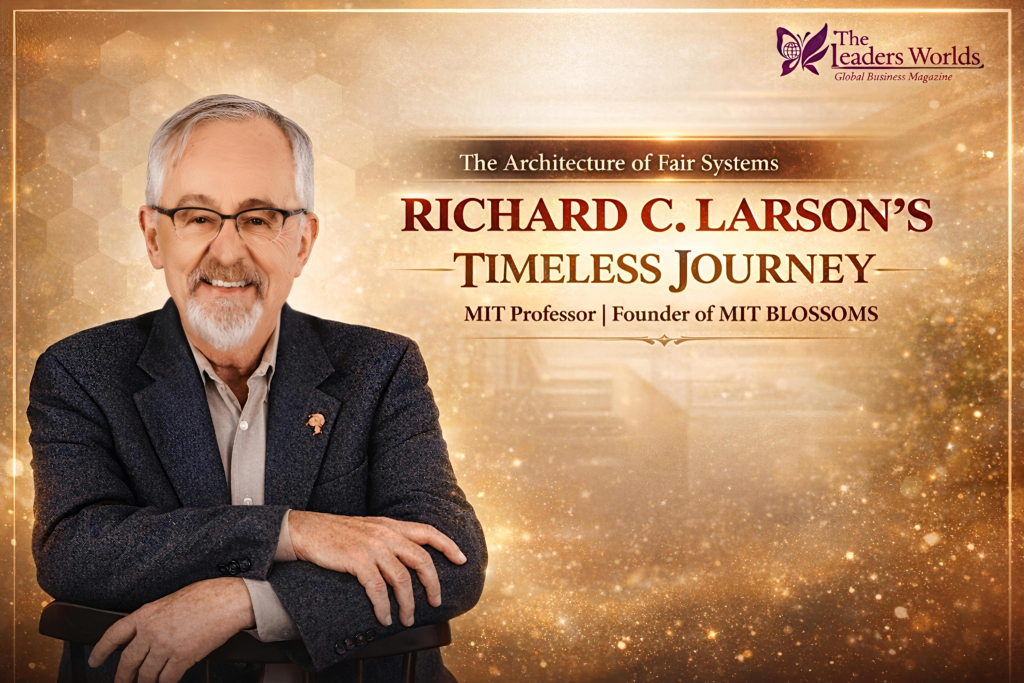
Richard C. Larson did not begin his career searching for fame or disruption. What drew him forward was a persistent curiosity about how complex systems affect ordinary people.
Born in 1943 and raised in a childhood marked by frequent moves, Larson grew accustomed to adapting quickly. Changing schools and communities sharpened his instinct to observe patterns. He noticed how structures guided behavior and how small inefficiencies could quietly frustrate lives.
When he arrived at MIT in the 1960s to study electrical engineering, that instinct followed him. Yet circuits and equations were only part of his interest. He wanted to understand how large systems functioned under real-world pressure and how they failed.
That curiosity would define his life’s work.
“Curiosity becomes impact when it refuses to stay theoretical.”
Rethinking the Experience of Waiting
One of Larson’s most influential contributions emerged from a deceptively simple situation: standing in line.
While others treated queues as mathematical puzzles, Larson examined the human response within them. He discovered that waiting is not experienced purely through time. It is experienced through perception. A lack of information creates anxiety. Visible fairness creates trust.
His research reshaped how institutions think about service systems. Efficiency mattered, but reliability and clarity mattered more.
Systems Under Stress
Larson’s attention turned toward environments where pressure magnifies weaknesses. Emergency response systems, healthcare logistics, and crisis modeling became central areas of his research.
He understood that stress exposes truth. In stable conditions, flaws remain hidden. Under strain, they surface quickly.
His work focused on preparation rather than reaction. He studied how information flows during emergencies, where bottlenecks develop, and how clarity can prevent cascading failures. Panic spreads rapidly in uncertainty. Clear structure prevents collapse.
As a professor at MIT, he carried the same discipline into leadership. In high-stakes discussions, he slowed conversations rather than escalating them. Seriousness did not require severity. Authority did not require volume.
“The real test of a system is not how it performs in calm moments, but how it holds when pressure rises.”
Expanding Access to Knowledge
As his career matured, Larson began asking broader questions about opportunity. Who benefits from world-class education? Who remains excluded?
These concerns led to the founding of MIT BLOSSOMS. As Founder of MIT BLOSSOMS, he helped build an initiative designed to bring advanced mathematics and science instruction to classrooms around the globe. The goal was not simply distribution of content. It was partnership.
Lessons were designed to pause, inviting teachers and students to engage actively rather than passively consume information. Technology supported dialogue rather than replacing it.
Through BLOSSOMS, classrooms far from MIT gained access to thoughtfully structured learning experiences.
Leadership Through Responsibility
Throughout his career, Larson treated positions not as personal milestones but as obligations. Whether guiding academic programs or expanding educational access, he approached each role with measured care.
He viewed systems as promises. A public service promises reliability. A classroom promises growth. An institution promises integrity. His work consistently sought to strengthen those commitments.
This mindset shaped a legacy defined not by spectacle, but by structure.
A Journey That Endures
Richard C. Larson’s influence is not always visible, yet it is deeply embedded in modern life. It appears in fairer service systems, more resilient emergency responses, and classrooms designed to invite participation.
His journey reflects continuity of principle rather than dramatic transformation. Fairness. Clarity. Preparation. Responsibility.
In an era captivated by speed and disruption, Larson’s work reminds us that durability requires patience. Systems must be designed carefully. Impact must be measured by consequence.
“What endures is not built for attention. It is built to keep working long after attention has moved on.”