
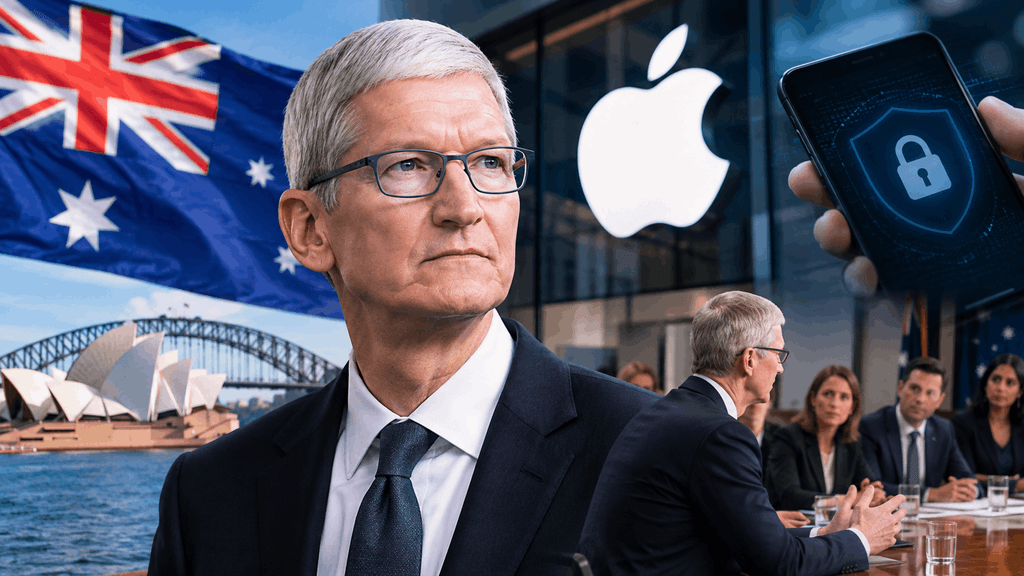
Apple Executive Chairman Tim Cook met Australian Prime Minister Anthony Albanese at Apple Park as Australia steps up pressure on technology companies over online safety, with Apple using the meeting to show its latest child safety features.
The meeting brought together two different approaches to the same problem. Australia is using regulation to change how digital services operate, while Apple is putting more controls directly into the devices and software families use every day. Albanese said Cook regarded Australia’s work on social media as “world-leading”, while Apple pointed to its own efforts to give parents more control over children’s digital experiences.
The timing also matters for Apple. Cook is now Executive Chairman, with John Ternus having taken over as CEO on September 1. Apple had announced the transition earlier this year and said Cook would continue to engage with policymakers around the world in his new role.
Apple’s New Child Safety Controls
Apple’s latest software updates give parents more control over what children can access, who they can communicate with and how much time they spend on different categories of apps.
The main additions include:
- Time Allowances, which let parents set daily limits across categories such as Social Media, Games and Entertainment.
- Redesigned Screen Time, which provides an at-a-glance view of usage and easier controls for changing access.
- “Ask to Browse”, which allows parents to require approval before children access a new website through Safari.
- Expanded Communication Safety, which now detects and intervenes when gore or violent content appears in shared images and videos, in addition to existing protections around nudity.
Apple made these features available with iOS 27, iPadOS 27 and macOS 27 on September 14. The company says the tools were informed by guidance from online safety and health experts, including the American Academy of Pediatrics.
The controls bring more responsibility into the operating system itself. Parents can manage access and usage without depending entirely on the settings offered by each individual app.
That still has limits. Apple controls the device, operating system and App Store, but it does not determine how third-party social platforms recommend content, moderate posts or manage their own services.
Australia Tightens Its Digital Rules
Australia has already moved beyond asking parents to manage that environment themselves.
Its social media minimum age rules took effect on December 10, 2025. Age-restricted platforms are required to take reasonable steps to prevent Australians under 16 from creating or keeping accounts. eSafety currently lists Facebook, Instagram, Snapchat, Threads, TikTok, Twitch, X, YouTube, Kick and Reddit among the age-restricted services.
The government is now proposing a broader framework through its Digital Duty of Care. The draft approach would establish minimum safety standards for digital services and place greater responsibility on providers to address risks associated with the systems they operate. The policy was released for consultation in September.
One of its more distinctive ideas is “My Feed, My Way”. Under the proposal, Australians over 16 would be able to choose whether their social media feed uses personalised recommendations or relies on content from accounts they have chosen to follow. The proposal is therefore about giving users more choice over recommendation systems rather than simply removing algorithmic feeds.
The approach goes beyond age restrictions. It also raises a broader question about how digital products are designed and how much responsibility should sit with the companies building them.
The Role Apple Can Actually Play
Apple does not run the social networks at the centre of Australia’s age restrictions, yet its products sit between users and many of those services.
An iPhone can determine which apps a child can access, how long they can use them and whether certain websites or communications require parental approval. The social platform remains responsible for what happens inside its own service.
That makes the question of responsibility less straightforward. Parents make some decisions, device makers control others, while apps and social platforms manage their own systems. Regulators are increasingly looking at what each part of that chain should do.
Albanese said Apple had worked to support Australia’s online safety laws and described Cook and Apple as showing that the industry can “compete on safety credentials, not just convenience.” The Prime Minister’s office made that statement after the meeting, while Apple’s public comments focused on its child safety tools and its broader commitment to helping keep children safe online.
That does not establish formal Apple support for every element of the proposed Digital Duty of Care. The distinction matters because Australia’s wider regulatory framework covers areas that extend beyond Apple’s own products.
The Responsibility Behind the Screen
A child’s online experience can move through a phone, operating system, app store, social platform and recommendation system before content reaches the screen. Each layer can influence what the user sees and what controls are available.
Australia is placing more responsibility on the companies that design those systems. Apple’s latest controls approach the same issue from the device side, giving families more ways to manage access before a child encounters potentially harmful content.
The meeting also touched on artificial intelligence. Albanese said governments need a global framework for AI as the technology develops quickly, adding that “we need to make sure that humans remain in control.” Reuters reported the comments following the Apple meeting.
For Apple, the meeting comes at an interesting point in its leadership transition. Cook is no longer running the company as CEO, but his new role still places him in discussions with policymakers around the world. At the same time, Apple has just introduced a new set of controls that gives families more direct authority over children’s use of its devices.
The meeting therefore leaves Apple at an intersection between product design and public policy. Australia is asking technology companies to take greater responsibility for the environments they create, while Apple is adding more safety controls at the device and operating-system level. How those responsibilities are divided is becoming a larger part of the technology debate, and Apple’s role in that discussion is becoming harder to separate from the products used by millions of families.