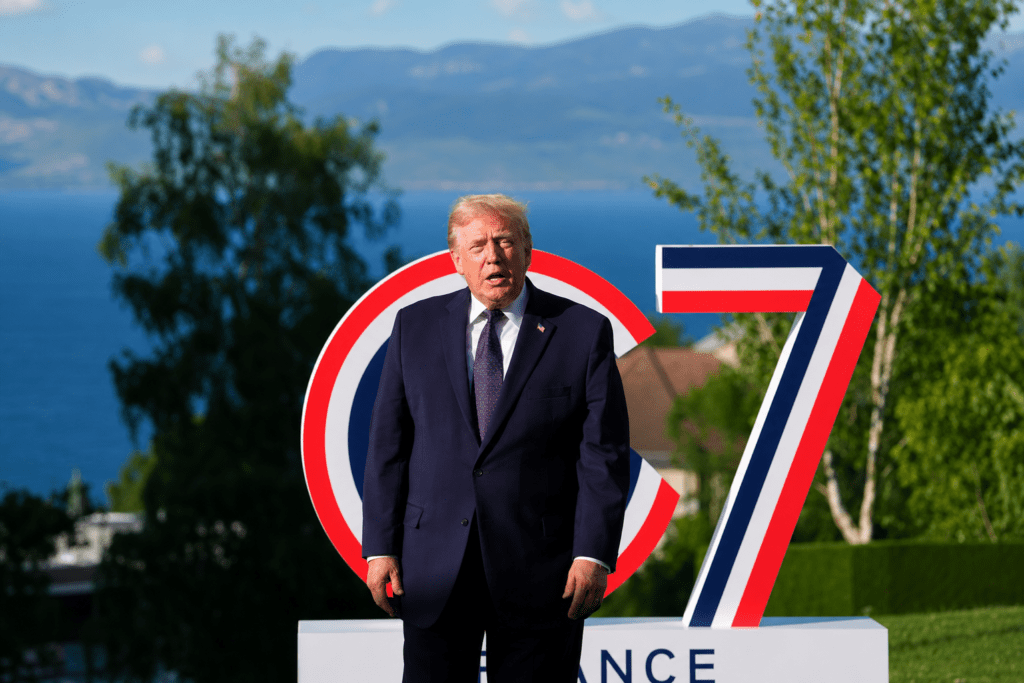
U.S. President Donald Trump said at the G7 Summit on Tuesday that a U.S.-Iran agreement aimed at preventing Tehran from obtaining a nuclear weapon is “all signed,” placing the proposed framework at the center of discussions among world leaders and global markets.
Speaking to reporters on the sidelines of the summit, Trump stated that the understanding clearly establishes that Iran will not obtain a nuclear weapon. Although the full text has not yet been released publicly, the announcement quickly became one of the most closely watched developments at the gathering in France.
The statement arrives at a critical moment for global energy markets and regional stability. Governments, investors, and businesses are paying close attention to the details emerging from the negotiations as they assess the broader impact of the agreement.
Focus on Nuclear Commitments
According to Trump, the framework makes it clear that Iran will not possess a nuclear weapon. The nuclear issue has remained at the center of tensions between Washington and Tehran, making it the most significant element of the understanding announced at the summit.
However, officials have not yet released detailed information regarding verification procedures, monitoring systems, or compliance requirements. While Trump described the arrangement as “all signed,” officials familiar with the discussions have indicated that the current framework still requires technical implementation and further negotiations on key operational details.
Those details carry significant weight because international agreements are ultimately measured by how commitments are implemented rather than how they are announced.
Deal Enters Second Phase
Trump told reporters that the agreement is now entering a “second stage,” shifting attention from the initial understanding toward implementation and technical negotiations.
Current discussions are expected to focus on nuclear oversight, compliance measures, verification procedures, and the practical mechanisms required to carry out commitments made under the framework. The next phase is considered critical because several operational details remain unresolved despite the political agreement announced at the summit.
The full text has yet to be released publicly, leaving governments and international observers waiting for greater clarity on the structure and scope of the proposed arrangement.
Strait of Hormuz Reopens
Another major element linked to the agreement is the Strait of Hormuz, one of the world’s most strategically important shipping routes.
According to data from the U.S. Energy Information Administration, nearly 20% of global petroleum liquids consumption moves through the Strait of Hormuz. Any disruption along this corridor can affect oil supplies, shipping activity, and energy prices across international markets.
Reports surrounding the framework suggest efforts are underway to restore normal commercial movement through the waterway and reduce risks to global energy flows. For businesses and governments alike, stability in the Strait of Hormuz remains one of the most important economic implications of the agreement.
The issue has also attracted significant attention at the G7 Summit, where leaders are closely monitoring developments that could influence energy security and global trade.
Energy Markets Find Relief
Financial markets responded quickly following Trump’s announcement.
Oil prices fell more than 2%, reaching their lowest levels in nearly three months, as traders reacted to reports of easing tensions and the possibility of more stable energy flows through the Strait of Hormuz.
Investors interpreted the development as a positive signal for global supply chains and energy security. The market reaction highlights how closely financial markets monitor geopolitical developments involving major oil-producing regions.
Even before the complete framework becomes public, expectations of fewer disruptions to global energy supplies have already influenced market sentiment. However, traders continue to monitor developments carefully as additional information emerges from ongoing discussions.
A 60-Day Negotiation Period
Despite Trump’s statement that the deal is “all signed,” the current understanding is widely viewed as a framework for the next stage of negotiations rather than a fully implemented long-term settlement.
Reports indicate that discussions over the coming weeks will focus on technical issues related to nuclear oversight, compliance measures, implementation procedures, and verification mechanisms. A proposed 60-day negotiation period is expected to provide both sides with time to address unresolved matters and establish the processes required to carry out the commitments outlined in the framework.
Several G7 leaders have also sought greater clarity on implementation measures and verification procedures before assessing the agreement’s full impact on regional security and global stability.
For now, Washington and Tehran appear to have moved closer to a diplomatic understanding. Markets have reacted, world leaders are assessing the implications, and attention remains focused on the details expected to emerge as negotiations continue.