
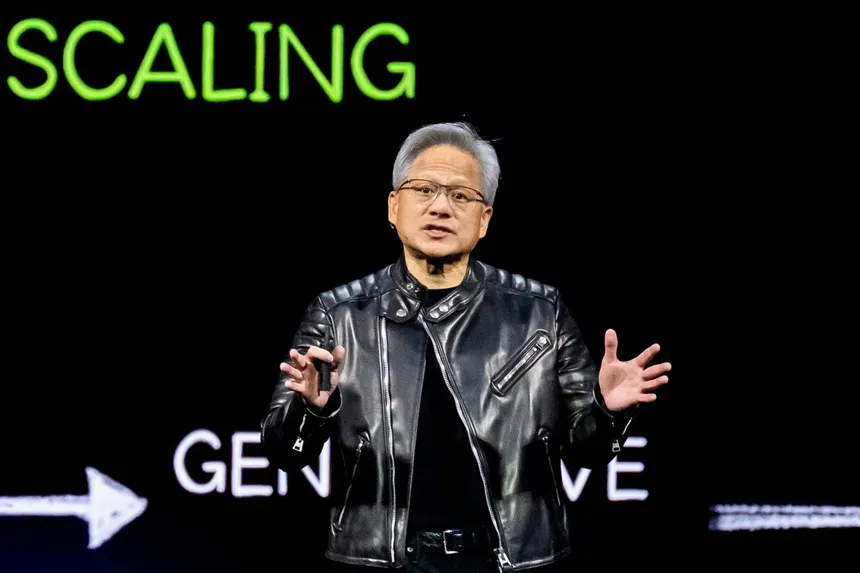
When people talk about artificial intelligence today, the conversation often jumps straight to tools, models, or fear. Faster systems. Smarter machines. Fewer jobs. But beneath all the noise, something quieter and far more consequential is happening. Artificial intelligence is no longer behaving like a technology trend. It is beginning to act like economic infrastructure.
Few leaders have explained this shift as clearly as Jensen Huang, CEO of Nvidia. His leadership does not rely on dramatic predictions. Instead, it rests on reframing how AI should be understood, planned for, and governed.
At CES 2026 and the World Economic Forum in Davos, Huang delivered a consistent message. AI is not a software wave that companies can choose to ride or ignore. It is becoming part of the foundation on which modern economies operate. That framing changes the responsibility of leadership entirely.
AI as the Largest Infrastructure Buildout in History
Huang has described the current AI moment as the largest infrastructure buildout humanity has ever seen. This is not a metaphor. He places AI in the same category as electricity and the internet, technologies that reshaped societies because they became embedded everywhere.
This perspective helps explain why investment levels feel unprecedented. Across the world, hundreds of billions of dollars are flowing into data centers, advanced chip manufacturing, energy systems, and industrial automation. These are not speculative bets. They are physical assets designed to last for decades.
What makes this moment different is the rise of what Huang calls “AI factories.” These are not general-purpose data centers. They are facilities purpose-built for accelerated computing, continuous model training, and large-scale deployment. Once constructed, they lock in long-term economic direction. That permanence raises an uncomfortable question for leaders. If AI infrastructure is built today, who bears responsibility for its long-term impact?
Huang has described the current AI moment as the largest infrastructure buildout humanity has ever seen. This is not a metaphor. He places AI in the same category as electricity and the internet, technologies that reshaped societies because they became embedded everywhere.
This perspective helps explain why investment levels feel unprecedented. Across the world, hundreds of billions of dollars are flowing into data centers, advanced chip manufacturing, energy systems, and industrial automation. These are not speculative bets. They are physical assets designed to last for decades.
What makes this moment different is the rise of what Huang calls “AI factories.” These are not general-purpose data centers. They are facilities purpose-built for accelerated computing, continuous model training, and large-scale deployment. Once constructed, they lock in long-term economic direction. That permanence raises an uncomfortable question for leaders. If AI infrastructure is built today, who bears responsibility for its long-term impact?
The Five-Layer AI Cake and Why Leadership Matters
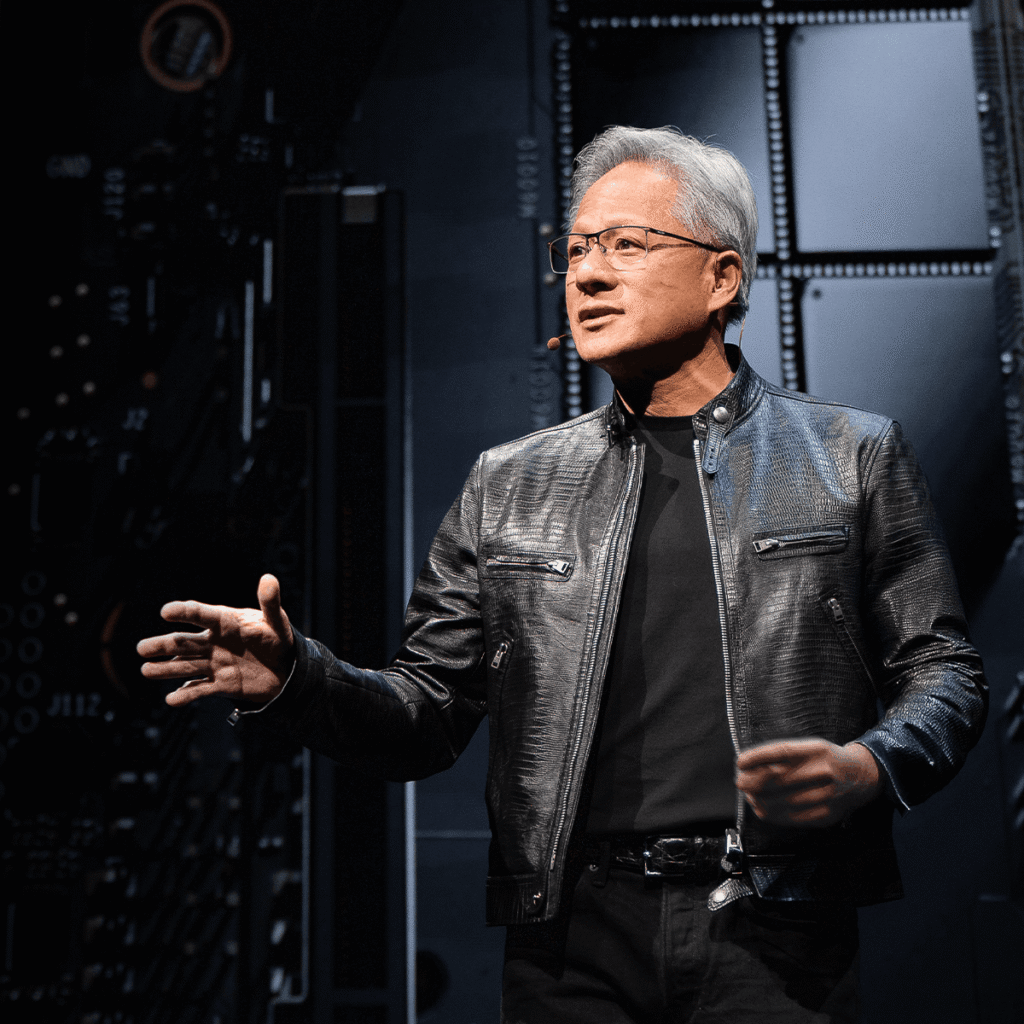
To explain why AI cannot succeed in isolation, Huang introduced a framework known as the five-layer AI cake. Each layer depends on the others, and weakness in one eventually affects all.
- Energy
AI infrastructure depends on massive, reliable power. This has pushed companies and governments toward nuclear, renewable, and grid expansion projects. - Chips and Computing
Advanced GPUs and accelerated computing systems sit at the core. Fabrication partners and memory suppliers are scaling production globally to meet demand. - Cloud Infrastructure
Hyperscalers and national cloud platforms are expanding data centers across regions, turning compute into a strategic asset. - AI Models
Foundation and reasoning models are trained on this infrastructure, but they are not the end goal. - Applications
Huang repeatedly stresses that real economic value emerges here. Healthcare, finance, manufacturing, logistics, and mobility are where productivity gains become measurable.
Huang repeatedly emphasizes that real benefit emerges only at the application layer. Models alone do not change economies. Use does. This system-wide thinking explains why his leadership resonates beyond the technology sector.
Jobs, Labor, and the Misunderstood Impact of AI
Public anxiety around AI often centers on job loss. Huang does not deny disruption, but he reframes it. His argument is simple. AI automates tasks, not purpose.
In healthcare, AI speeds up diagnostics but increases demand for professionals who interpret results and care for patients. In nursing, automation reduces administrative load, improving productivity and encouraging hospitals to hire more staff.
Less discussed is the physical side of the AI economy. Building AI infrastructure requires electricians, plumbers, steelworkers, cooling specialists, and network technicians. These roles cannot be outsourced or automated. In many regions, they are becoming some of the most stable and well-paid jobs available.
This introduces a deeper tension. If AI creates opportunity, will education systems and leadership decisions ensure people can access it?
Sovereign AI and National Responsibility

Huang’s leadership increasingly touches geopolitics. He urges nations to build sovereign AI, meaning control over data, models, and computing infrastructure. His warning is direct. Dependence on foreign AI systems carries long-term strategic risk.
Countries across Asia, Europe, and the Middle East are responding with large domestic investments. Europe, in particular, has an opportunity to combine its industrial strength with AI to lead in robotics and advanced manufacturing.
This shift places corporate leaders in unfamiliar territory, where business strategy and national policy intersect.
What Jensen Huang’s Leadership Ultimately Reveals

Huang’s leadership reveals three realities about the AI economy.
First, AI is infrastructure, not a trend. It requires long-term investment and physical commitment.
Second, productivity does not automatically reduce employment. When applied thoughtfully, AI reshapes work and expands opportunity, especially in skilled trades and services.
Third, AI is now inseparable from national competitiveness. Corporate strategy, labor markets, and public policy are deeply connected.
As of January 2026, the AI economy is no longer forming. It is already operational. Jensen Huang’s clarity lies in explaining that adaptation is no longer optional. It is the baseline for survival in the modern economy.